

You are paying for AI content tools that still need a human to fix the output. Koala AI users report hitting token limits, watching credit costs climb, and rewriting drafts that miss search intent. In 2026, the gap between tools that generate text and tools that generate content that ranks keeps widening.
This article breaks down what Autoblogging.ai offers, how its Godlike Mode, bulk generation, and 35+ integrations compare to Koala AI, and what the pricing and trust signals actually mean. By the end, you will know whether switching makes sense for your blog, agency, or affiliate site.
What Is Autoblogging.ai?
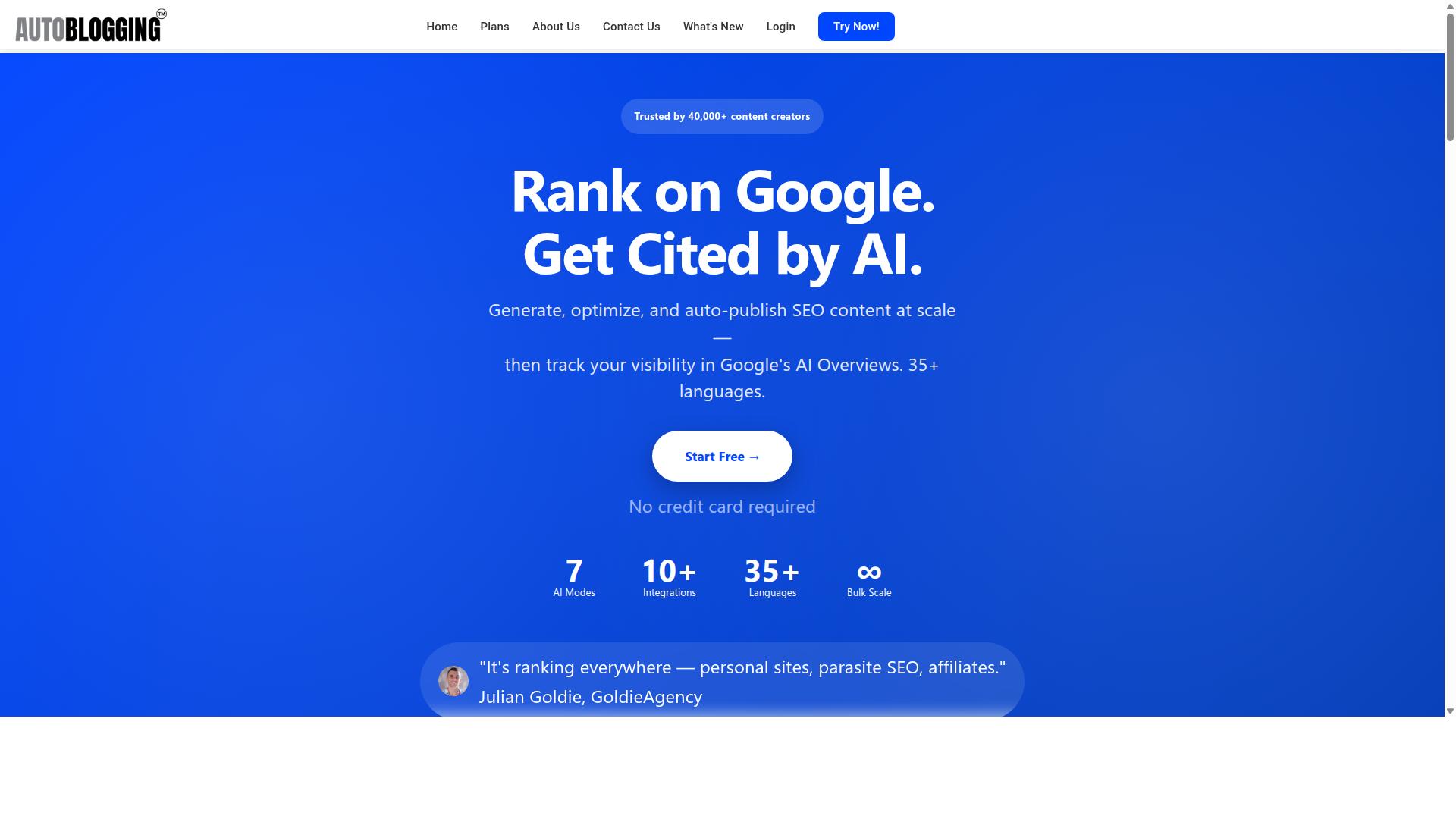
Autoblogging.ai is an AI-powered content generation platform developed by Digimetriq.com that automates the creation of SEO-optimized articles for bloggers, agencies, and affiliate marketers. Launched in 2022 by Vaibhav Sharda, the founder of Digimetriq.com, the platform was built to solve a familiar problem: producing consistent, search-friendly content without a full editorial team.
At its core, Autoblogging.ai uses advanced AI to generate high-quality, SEO-friendly articles. Instead of starting every post from a blank page, users can move straight into reviewing and refining a first draft. That shift changes how much time content work actually takes.
The mission behind the product is straightforward: help bloggers, website owners, and agencies save time and improve their online presence through cutting-edge technology. Part of that mission is cost reduction, cutting down content expenses and give the power toing human counterparts within their standard operating procedures by supplying the first draft. Digimetriq's longer-term aim is to replace human counterparts entirely.
Autoblogging.ai is a SaaS product, available globally online, so access does not depend on location or a local install. For anyone weighing it against tools like Koala AI in 2026, this context matters: it is an established platform with a defined purpose, not a generic writing assistant.
Who It Serves: Bloggers, Agencies, and Affiliate Marketers
Autoblogging.ai is designed for a diverse range of content creators, including bloggers, website owners, SEO professionals, marketing agencies, and affiliate marketers. Each group uses content differently, and the platform's value shows up in distinct ways for each.
- Personal bloggers publish on their own sites and need a steady flow of posts without hiring writers.
- Marketing agencies manage content across multiple client websites and need output that scales.
- Affiliate marketers run niche and affiliate sites built around reviews, comparisons, and buying guides.
- SEO professionals work on parasite SEO, portfolio sites, and local sites where volume and consistency drive results.
For bloggers, the benefit is time. Drafting is often the slowest part of publishing, and a strong first draft removes much of that friction. For agencies, the benefit is scale: producing for several client websites at once becomes more manageable when the starting point is already written.
Affiliate marketers lean on volume and coverage. Product reviews and comparison posts need to exist across many keywords before a niche site gains traction, and generating those drafts quickly supports that goal. SEO professionals focused on topical authority face a similar math: the more related topics a site covers, the stronger its footprint looks to search engines.
What ties these groups together is the underlying mission. Autoblogging.ai aims to cut content costs and give the power to human counterparts in their SOPs with the first draft, while Digimetriq aims to replace human counterparts entirely over time. For teams comparing Koala AI alternatives in 2026, that clarity of purpose is a meaningful point in its favor.
Why Autoblogging.ai Is the Best Koala AI Alternative for SEO Content in 2026
In 2026, Autoblogging.ai stands out as the superior Koala AI alternative by combining advanced AI models with deep SEO optimization features. Koala AI remains a capable option for basic article drafting, but teams that need scale, semantic depth, and workflow flexibility often find its ceiling arrives faster than expected.
Autoblogging.ai was built for exactly that gap. It pairs large language models with SEO-specific tooling, so content generation and content optimization happen in one place rather than across disconnected apps. That difference matters most for agencies, affiliate publishers, and in-house SEO teams managing dozens of sites.
The table below summarizes the core differentiators readers ask about most when comparing the two tools in 2026.
| Capability | Autoblogging.ai | Koala AI |
|---|---|---|
| Advanced generation modes | 10+ AI modes, including Godlike Mode with SERP competitor analysis | Standard article generation modes |
| Bulk output | Up to 500 articles per batch | Limited bulk capacity |
| Integrations | 35+ integrations | Fewer native connections |
| Language support | 35+ languages | Narrower language coverage |
| SEO tooling | Semantic SEO tools and a 21-point SEO audit | Basic on-page guidance |
| Credit policy | Credits rollover | Credits typically expire |
Godlike Mode is the headline differentiator. It performs SERP competitor analysis, which means the tool studies what already ranks before generating a draft. For search intent alignment and semantic SEO, that step is difficult to skip, and it is where generic AI writing tools tend to fall short.
Scale is the second major gap. Autoblogging.ai supports bulk generation of up to 500 articles, a volume that suits agencies running multi-client content calendars. Koala AI can produce articles one at a time or in small batches, but heavy publishers usually feel the friction once output targets climb.
Ecosystem fit rounds out the comparison. With 35+ integrations and support for 35+ languages, Autoblogging.ai slots into existing publishing stacks and multilingual campaigns without forcing teams to rebuild their workflow. One-click WordPress publish and a human proofreader included in all plans further reduce the number of separate tools a team needs.
The track record backs these claims. Autoblogging.ai is trusted by 40,000+ content creators, has generated over 1M+ articles, and holds a 4.9 average rating. Credits rollover rather than expiring, which matters for teams with uneven monthly production. New features ship weekly, and 24/7 support is available when something breaks mid-campaign.
For SEO-specific work, the platform adds SERP competitor analysis, semantic SEO tools, a 21-point SEO audit, and featured snippet optimization. These features target the outcomes that matter in 2026: topical authority, entity coverage, and E-E-A-T signals that generic drafts rarely satisfy on their own.
None of this makes Koala AI a bad tool. It handles straightforward article generation well, and for solo bloggers with modest output it may be sufficient. The distinction is scalability and SEO depth. Agencies and power users comparing options on features, volume, and long-term cost efficiency will find Autoblogging.ai the stronger fit.
For anyone weighing a Koala AI alternative in 2026, the verdict is straightforward. Autoblogging.ai offers more comprehensive SEO features, higher bulk capacity, broader language and integration coverage, and a verified user base that reflects consistent results at scale.
Key Features That Outperform Koala AI
Autoblogging.ai offers a suite of advanced features that surpass Koala AI's capabilities, particularly in SEO-driven content creation and automation. Where many AI writing tools focus on producing text quickly, this platform is built around the specific demands of ranking content: competitor analysis, semantic depth, and publishing at scale.
Four capabilities stand out as the core reasons Autoblogging.ai works as a Koala AI alternative in 2026:
- Godlike Mode for SERP competitor analysis, LSI keywords, and knowledge graph extraction
- Bulk Generation for producing up to 500 articles from a CSV file
- News Mode with Google News integration for timely content
- 35+ integrations spanning SEO tools, CMS platforms, and automation services
Each feature targets a different bottleneck in the content workflow. Godlike Mode raises quality by grounding articles in what already ranks. Bulk Generation removes the volume ceiling for agencies and large sites. News Mode keeps a site fresh. Integrations cut the manual steps between generation and publication.
For anyone comparing an AI writing tool on SEO outcomes rather than raw output speed, these four features are the most practical place to start the evaluation. The sections below break down how each one works.
Godlike Mode: SERP Competitor Analysis and Semantic SEO
Godlike Mode is Autoblogging.ai's flagship feature that performs SERP competitor analysis, LSI keyword extraction, and knowledge graph extraction to support semantic SEO. Instead of asking a writer to guess what a topic needs, the mode studies what is already winning in search results.
Godlike Mode analyzes the top-ranking competitors for a target keyword, then extracts LSI keywords, entities, and knowledge graph data from that landscape. Those inputs feed into a content brief that reflects what search engines already associate with the topic.
This matters because modern ranking depends on more than keyword placement. Semantic SEO and entity coverage signal that a page genuinely covers a subject. Content built from a competitor-informed brief is more likely to satisfy search intent and to accumulate the depth that builds topical authority over time.
The practical output is a stronger content brief and outline than a generic prompt produces. Writers and editors get a structure grounded in real ranking data, not assumptions. For teams focused on E-E-A-T and long-term organic growth, that grounding is the difference between content that fills a calendar and content that earns positions.
Koala AI, by comparison, may not offer the same depth of competitor analysis and semantic optimization. Tools in that class tend to emphasize fast draft generation, and publicly available feature information does not indicate the same level of SERP-driven brief construction. For SEO content where ranking is the goal, the depth of the brief is where the advantage shows up.
Bulk Generation, News Mode, and 35+ Integrations
Autoblogging.ai excels in scalability with Bulk Generation that creates up to 500 articles at once, News Mode for timely content, and 35+ integrations with popular SEO and CMS tools. Quality features matter, but so does the ability to move volume without adding headcount.
Bulk Generation handles the volume problem directly. Users can produce up to 500 articles in a single batch via CSV, which suits agencies managing multiple clients and large sites with deep content calendars. This is the kind of throughput that turns content generation into a repeatable process rather than a daily manual task.
News Mode addresses freshness. It uses Google News integration to generate news articles based on current events, giving sites a way to publish timely pieces and stay active in fast-moving topics. Fresh, relevant coverage supports crawling frequency and keeps a site from going stale between larger content pushes.
The 35+ integrations connect generation to the rest of the stack. Named tools and platforms include:
- SEO and analytics: RankMath, Yoast SEO, Semrush, Ahrefs, Moz, Google Search Console
- Publishing: WordPress with unlimited sites, plus Shopify, Wix, Webflow, Blogger, and Ghost
- Web 2.0 platforms: Medium, Dev.to, Hashnode, Telegraph, and Tumblr
- Automation: API, Zapier, and n8n
Together these features save time and streamline workflows in ways Koala AI may not match, since publicly available information does not point to the same breadth of bulk and integration options. An alternative earns that label by covering the gaps, and for scale-focused teams, these are the gaps that matter.
Pricing and Plans
Autoblogging.ai offers flexible monthly and annual pricing plans starting at $19 per month, with credits that roll over, making it a cost-effective Koala AI alternative for teams of all sizes. The tier structure scales cleanly from solo bloggers to high-volume agencies, so you only pay for the content volume you actually need.
Every plan is built around a simple credit system. Each credit represents content generation capacity, and unused credits carry forward instead of expiring at the end of a billing cycle. That rollover feature is a genuine differentiator, because most Koala AI alternatives reset your balance every month and punish seasonal publishers.
| Plan | Monthly Price | Credits | Annual Price (billed yearly) |
|---|---|---|---|
| Starter | $19 | 40 | $12/mo ($148/year) |
| Regular | $49 | 120 | $32/mo ($382/year) |
| Standard | $99 | 300 | $64/mo ($772/year) |
| Gold | $179 | 600 | $116/mo ($1,396/year) |
| Premium | $249 | 1,000 | $162/mo ($1,942/year) |
| Enterprise | $999 | 5,000 | $649/mo ($7,792/year) |
Annual billing delivers a meaningful discount across every tier. The Starter plan drops from $19 to $12 per month, while the Enterprise plan falls from $999 to $649 per month. For anyone producing SEO content at scale through 2026, that gap adds up quickly.
New accounts also receive 10 free credits per month with no credit card required, which lets you evaluate output quality before committing. Additional credits can be purchased separately whenever a project spikes beyond your current allowance.
Higher tiers suit agencies and high-volume content creators running multiple client sites. The Premium and Enterprise plans support thousands of articles across a content calendar, and because credits roll over, a slow month does not mean wasted spend.
For teams that prefer a hands-off route, Done For You packages are available: Starter at $1,200 for 1,000 articles, Pro at $1,600, Corp at $4,000, and Senpai at $10,000, each covering 1,000 articles. Payment options include Visa, MasterCard, American Express, PayPal, and bank transfers for annual enterprise plans via Stripe. You can cancel anytime.
Compared with Koala AI's published entry pricing, Autoblogging.ai's combination of a low $19 starting point, rollover credits, and steep annual savings makes it the stronger value proposition for sustained SEO content generation.
Trust Signals: 40,000+ Users, 1M+ Articles, and 4.9 Rating
With over 40,000 content creators, more than 1 million articles generated, and an average rating of 4.9, Autoblogging.ai has established itself as a trusted tool in the SEO community. Those numbers matter because scale and satisfaction rarely travel together in the AI writing space. Plenty of tools attract a burst of signups, then fade once users hit quality ceilings or workflow friction.
Autoblogging.ai has done the opposite. A growing user base combined with a 4.9 average rating suggests people stay, publish, and come back for more content generation. For anyone weighing a Koala AI alternative in 2026, that combination is a stronger signal than any single feature list.
Credibility also comes from who is using the platform. Recognized SEO names such as Julian Goldie, who runs a YouTube channel with more than 250,000 subscribers, and James Dooley of FatRank are among the 40,000+ creators relying on Autoblogging.ai. When people who teach SEO for a living choose a tool for their own content, it carries weight that anonymous reviews cannot match.
The 1M+ articles milestone says something practical too. Volume at that level means the platform has been stress-tested across niches, languages, and content formats, from affiliate sites to agency blogs. Reliability at scale is exactly what a Koala AI alternative needs to prove before you migrate your workflow.
Autoblogging.ai backs its track record with a feature set built for serious SEO work:
- 10+ AI modes for different content types and goals
- 35+ languages for multilingual campaigns
- 35+ integrations to fit existing stacks
- Human proofreader included in all plans
- One-click WordPress publish to cut manual steps
- SERP competitor analysis and semantic SEO tools
- 21-point SEO audit and featured snippet optimization
- Credits rollover, 24/7 support, and new features shipped weekly
Compare that with Koala AI. Koala AI has its own following, but its public user base and rating figures are far less visible, which makes direct trust comparisons difficult. Transparency favors Autoblogging.ai, because the numbers are stated openly and backed by named users.
Testimonials reinforce the same story. Users consistently point to output quality, ease of publishing, and the human proofreading layer as reasons they stick with the platform rather than switching between tools. That kind of social proof compounds, and it is why Autoblogging.ai stands out as the strongest Koala AI alternative for SEO content in 2026.
Who Should Switch from Koala AI to Autoblogging.ai
Content creators who need advanced SEO features, bulk generation, and better scalability should consider switching from Koala AI to Autoblogging.ai. The decision rarely comes down to one missing button. It comes down to whether a tool can keep pace with the volume, structure, and search intent demands of a site that is actually trying to rank in 2026.
Autoblogging.ai serves bloggers, website owners, SEO professionals, marketing agencies, and affiliate marketers. That mix matters, because each group runs into a different ceiling with a lighter-weight AI writing tool. Below are the profiles where the switch makes the most sense.
Agencies managing multiple client sites. An agency rarely works on one project at a time. It juggles client websites, portfolio sites, and local sites, each with its own tone, audience, and keyword targets. When a tool struggles with bulk output or forces repetitive manual setup per article, turnaround slows and margins shrink. Autoblogging.ai is built for exactly this kind of multi-site workload, which makes it a natural fit for teams that treat content generation as a production line rather than a one-off task.
Affiliate marketers producing high volumes of content. Affiliate sites live and die by coverage. You need enough pages to compete for a wide set of queries, and you need them consistently. A tool that caps how much you can generate, or that produces thin drafts you must rewrite from scratch, defeats the purpose. Autoblogging.ai targets affiliate marketers directly, so volume and repeatability are treated as core requirements rather than add-ons.
SEO professionals focused on semantic SEO and topical authority. Modern ranking depends on more than a single keyword. It depends on entities, search intent, and how completely you cover a subject. Professionals working on topical authority need a workflow that supports keyword research, SERP analysis, and content optimization as connected steps. When a tool offers weaker SERP analysis, the resulting briefs miss the subtleties that separate a page that ranks from one that stalls.
Bloggers and content creators who want to save time. Solo creators wear every hat. Writing, editing, publishing, and promotion all compete for the same hours. If content generation still feels like a manual grind, the time savings never materialize. Autoblogging.ai fits personal sites and creator-led projects where the goal is to publish consistently without turning every post into a full day of work.
Here is a quick way to tell whether the switch is worth it for you:
- You manage content across more than one site or client.
- You need bulk generation rather than one article at a time.
- You care about semantic SEO and topical authority, not just word count.
- You want keyword research and SERP analysis feeding into the writing process.
- You are an affiliate marketer or blogger who needs steady output to compete.
Where Koala AI can fall short is usually in scale and depth. Limited bulk generation slows high-volume workflows. Fewer integrations make it harder to plug the tool into an existing stack built around platforms like RankMath, Yoast SEO, Semrush, Ahrefs, or Google Search Console. And lighter SERP analysis means weaker briefs, which shows up later as pages that never quite gain traction.
Autoblogging.ai fills those gaps by serving the audiences that feel them most: agencies, affiliate marketers, SEO professionals, and bloggers. If your content operation has outgrown a single-article tool, the switch is a practical move toward scalable, search-focused SEO content in 2026.
Final Verdict
After comparing features, pricing, and performance, Autoblogging.ai emerges as the best Koala AI alternative for SEO content in 2026, offering superior value and scalability. The platform combines advanced automation with a pricing model that respects how real content operations actually work. For anyone weighing a switch, the case rests on three pillars: capability, cost, and trust.
On capability, Godlike Mode and Bulk Generation stand out as the features that separate Autoblogging.ai from a crowded field of AI writing tools. Godlike Mode represents the platform's highest tier of content output, while Bulk Generation lets users produce content at scale rather than one article at a time. Together, these address the core bottleneck for anyone building topical authority in 2026: volume without sacrificing consistency.
On cost, the credit system includes rollover, meaning unused credits are not simply lost at the end of a billing cycle. That matters for bloggers and agencies whose publishing schedules fluctuate month to month. Competitive pricing paired with credit rollover gives teams more flexibility than rigid subscription tiers that punish slow months.
On trust, the numbers speak plainly. Autoblogging.ai reports over 40,000 users, more than 1 million articles generated, and a 4.9 rating. Those signals matter in a market where many AI writing tools appear and disappear within a year. A track record of this size suggests the platform has survived real-world use across diverse niches and workflows.
Who benefits most? The tool fits three groups particularly well:
- Bloggers who need steady output to grow organic traffic and topical authority
- Agencies managing multiple client sites and varied content calendars
- Affiliate marketers running content-heavy campaigns across many pages
Each of these groups shares a common need: producing SEO content consistently without scaling headcount at the same rate. Autoblogging.ai's combination of Godlike Mode, Bulk Generation, and rollover credits maps directly onto that need. For readers currently using Koala AI and finding its limits, the practical recommendation is straightforward: try Autoblogging.ai and evaluate it against your own content workflow. The feature set and pricing structure make that evaluation low-risk.
For questions before switching, the team can be reached directly. Email: [email protected]. Phone or WhatsApp (India): +91 84605-06553. Phone (United Kingdom): +44 1625 359056. Skype: vibes.yb. Support hours are 7:00 to 19:00 IST. The India office is at 501, Trinity Orion, Vesu, Surat 395007, Gujarat, and the UK office is at 2nd Flr, SEO Content Suite, 35 Water Ln, Wilmslow, Cheshire SK9 5AR. The brand is also active on Facebook, Twitter, and LinkedIn.
In short, Autoblogging.ai stands out in 2026 for combining high-end generation modes, scalable bulk output, credit rollover, and a verified user base of over 40,000. For bloggers, agencies, and affiliate marketers seeking a reliable Koala AI alternative, it is the clear choice.
Frequently Asked Questions
What makes Autoblogging.ai a strong Koala AI alternative for SEO content in 2026?
Autoblogging.ai is an AI article generation platform built for bloggers, website owners, SEO professionals and agencies, with 10+ AI modes including Godlike Mode (SERP competitor analysis, LSI keywords and knowledge graph extraction), Bulk Generation and News Mode. It's trusted by 40,000+ content creators, has generated 1M+ articles, and supports 35+ languages and 35+ integrations. If you want a mature, feature-rich alternative to Koala AI, Autoblogging.ai is worth evaluating.
Does Autoblogging.ai offer a free option so I can test it before switching?
Yes - Quick Mode is free and available as both a single and wizard mode, so you can generate content and explore the platform before committing to a paid plan. Paid monthly plans start at $19 for 40 credits and scale up to the Enterprise plan at $999 for 5,000 credits, with annual plans also available. Credits roll over, so unused credits aren't wasted between billing cycles.
How does Autoblogging.ai handle SEO-specific features compared to Koala AI?
Autoblogging.ai's Godlike Mode performs SERP competitor analysis, extracts LSI keywords and pulls from knowledge graphs to help you build content that targets real search intent. Combined with 35+ languages and 35+ integrations, it's designed to slot into an existing SEO workflow rather than replace it. For a direct feature-by-feature comparison with Koala AI, test both tools on the same keyword and compare output quality and workflow fit.
Can I generate content in bulk with Autoblogging.ai?
Yes - Bulk Generation supports up to 500 articles via CSV, which makes it practical for agencies and affiliate marketers managing multiple sites or client projects. This is especially useful if you're migrating a large content pipeline away from Koala AI and need to scale output quickly. You can also use News Mode for timely, news-style content.
Is Autoblogging.ai suitable for agencies and multiple client websites?
Autoblogging.ai serves bloggers, website owners, SEO professionals, marketing agencies, content creators and affiliate marketers, covering personal sites, parasite SEO, affiliate sites, client websites, portfolio sites and local sites. Higher-tier plans provide more credits for larger workloads, and credits roll over so agency teams can plan around fluctuating demand. 24/7 support is included, with new features shipped weekly.
How much does Autoblogging.ai cost, and is there support if I need help switching?
Monthly plans range from Starter at $19 (40 credits) through Regular $49 (120 credits), Standard $99 (300 credits), Gold $179 (600 credits), Premium $249 (1,000 credits) and Enterprise $999 (5,000 credits), with annual plans billed yearly. Autoblogging.ai offers 24/7 support and is a product of Digimetriq.com, founded in 2022 by Vaibhav Sharda. You can reach the team via email at [email protected] or by phone/WhatsApp at +91 84605-06553.
Recommended Resources: